Isnin, April 02, 2018
Selasa, November 17, 2015
Kunjungan Pimipinan Pakatan Harapan Ke Rumah Duta Perancis - 17 Nov 2015
Menyampaikan rasa simpati atas kejadian di Paris, pimpinan Pakatan Harapan diketuai oleh Presiden PKR, Datuk Seri Dr. Wan Azizah Wan Ismail, telah membuat kunjungan kepada Duta Perancis, Christophe Penot, di rumah beliau.


Baca lagi...
Rabu, Februari 19, 2014
Dr Mahathir berbohong tentang Kassim Ahmad, kata bekas ketua Persatuan Ulama

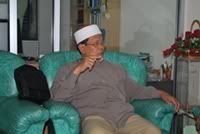
Ahmad Awang meneliti dokumen tentang
Kassim Ahmad sebelum diserahkan kepada
The Malaysian Insider. – Gambar The Malaysian Insider, 19 Februari, 2014.
Bekas Perdana Menteri, Tun Dr Mahathir Mohamad didakwa berbohong apabila berkata para ulama di negara ini gagal melawan Dr Kassim Ahmad dengan hujah, lalu melabelkannya sebagai 'anti-Hadis'.
Bekas Presiden Persatuan Ulama Malaysia (PUM), Ustaz Ahmad Awang berkata, ketika kejadian pertama Kassim membawa teorinya pada tahun 1986, beliaulah ketika itu Pengarah Penyelidikan Pusat Islam (kini Jakim) yang berdepan dengan Kassim.
"Atas kapasiti sebagai Yang di-Pertua PUM, kami berdepan dengan Kassim di Masjid Seksyen 16, Petaling Jaya. Beliau meminta kami dengarkan dulu dia bercakap, selepas dia bercakap, masa habis, dan dia pulang ke Pulau Pinang.
Baca lagi...
Ahad, Februari 16, 2014
[Video] The Syrian Opposition, Explained
Source: The NY Times
By Reem Makhoul and Liam Stack. February 7th, 2014
There are believed to be hundreds, if not thousands, of groups fighting in Syria. These opposition groups are fighting the Assad regime, but recently turned on each other with increased ferocity.
Source: The NY Times
Baca lagi...
As Hate Crimes Rise, British Muslims Say They’re Becoming More Insular
Source: The NY Times
By STEVEN ERLANGERFEB. 13, 2014

BIRMINGHAM, England — Alum Rock, a neighborhood of Birmingham, looks the way Pakistan might, if Pakistan were under gray northern skies and British rule.
The streets are lively but orderly, with shops that provide the largely South Asian population with most of its needs. The huge Pak Supermarket, with its 10-kilogram bags of spices and rices, is matched by the nearby Pak Pharmacy. Nearly every face is South Asian, and people wear a vibrant mixture of clothing, from Western styles to head scarves, knitted caps and full-face veils, or niqabs.
But the Muslims of Alum Rock, Washwood Heath and Sparkbrook, who make up most of the more than 21 percent of Birmingham’s population who declare Islam as their religion, are newly uneasy, they say. The backlash from the killing of a white soldier, Lee Rigby, in London in May by two fanatical young British Muslims, combined with anxieties about the flow of jihadis between Britain and Syria and the sometimes harshly anti-immigrant tone of leading British politicians have combined to create a new wariness among British Muslims.
“It is a less comfortable country than it used to be,” said Sadruddin Ali, 35, born and raised here.
Anti-Muslim hate crimes are up, the police and Muslim advocacy groups say. In response, many British Muslims say they are becoming more insular and more reluctant to leave their areas of Britain’s big cities, where they are among other Muslims and South Asians.

To many Muslims and non-Muslims, that is a worrying trend in what is considered to be a generally tolerant country as it heads toward the 2015 general election. A divided Conservative Party has a populist, anti-immigration party to its right in the U.K. Independence Party, and even the opposition Labour Party is supporting restrictions on benefits for immigrants.
“There is more hostility and more aggression,” Mr. Ali said.
He mentioned the firebombing of a nearby mosque after the Rigby killing, as well as the fatal stabbing in April of Mohammed Saleem, 82, as he left a local mosque. His attacker was a recent Ukrainian immigrant, who also placed three small bombs outside mosques. In June, a police officer and three other people were stabbed outside another Birmingham mosque.
In other parts of Britain, Mr. Ali said, “I feel a bit intimidated and don’t feel welcome, to be honest.” When he travels, he is often pulled aside at the airport for special questioning, he said, adding that this happened “even when I was cleanshaven.”
Mohammad Naseem, chairman of the Central Mosque in Birmingham, one of Britain’s largest, is 89. Born under British colonialism, he served as a doctor in the British Army and came here in 1959. He said he understands why Muslims are uneasy and defensive these days.
“When you go outside the boundary, you’re not sure where you stand,” he said. He said he sees the new fashion for Islamic head covering and veils less as religious than as a reaction to outside pressure. “When you’re being downgraded or threatened,” he said, “there is a natural reaction to hit back and say, ‘This is my identity.’ ”
In London, anti-Muslim episodes rose from 318 in 2011 and 336 in 2012 to 500 by mid-November in 2013, the police reported. The Greater Manchester Police recorded 130 offenses in 2013 compared with 75 in 2012. The West Midlands Police force, which covers Birmingham, reported in response to a freedom of information act request that there were 26 anti-Islamic hate crimes in 2011, 21 in 2012 and 29 through October 2013.
Tell MAMA, an advocacy group that monitors anti-Muslim episodes nationwide (MAMA stands for “measuring anti-Muslim attacks), said that such episodes had almost doubled in a year, with a surge after the Rigby killing, to nearly 1,000 cases. But the group does not separate online attacks from physical ones.


It is not clear how the current tensions will affect what some analysts say has been a slow but gradual trend of greater racial understanding in Britain, though periodically interrupted by racial and ethnic eruptions of hostility. News media attention to immigration from within the European Union has also helped dilute the focus on Muslims.
“Islamophobia intensifies after big events like 9/11, 7/7 and the Lee Rigby murder, and anti-Muslim hate crimes spike,” said Humayun Ansari, a professor of Islamic history at Royal Holloway, University of London, referring to the July 7, 2005, bomb attacks in London. “Then it actually fades away and dies down to a much lower level of intensity.”
But younger Muslims, like Sameera Hussain, 19, a student who wears a head scarf, said she sometimes got insulting or aggressive comments when she traveled outside her community, things like, “We’ll take your scarf and wrap it around your neck.”
Mohammed Wagas, 18, said he feels he is treated differently by the police, who in his opinion stop Muslim drivers “with nice cars” more often than other people. “Oh, you know, he’s brown, he’s going to be doing drugs, that’s why he’s rolling in a big car.”
Somaya Cheraitia described moving to a predominantly white area; casual insults intensified when she started to wear the niqab two years ago. “I was very different to what they knew, and I was an easy target,” she said. Stones were thrown at her family house and lit firecrackers put through the front mail slot teenagers grabbed her mother’s groceries and spilled them on the ground, yelling: “You’re rubbish anyway.”
Then a group of young women attacked her, she said, some trying to untie her niqab while another set her dog on Ms. Cheraitia, saying, “You’re both of the same breed.” When they managed to uncover her face, she remembers, one said: “Oh, she’s ugly anyway, look.”
She was shaken, and decided to stop wearing the niqab. “It was too much,” she said. “I felt like I didn’t belong, even if it’s your home. It was emotionally draining.” She said: “I wasn’t safe anywhere. I wanted to be strong in my worship to Allah,” but her fear “was too strong,” and she moved back to more comfortable East London less than a year ago.
Mr. Naseem noted that anti-Muslim fear and hatred went back to the Crusades, with pubs called “Turk’s Head” or “Saracen’s Head,” but he attributes most anti-Islam and anti-immigration commentary to political language devised to win votes.
But for all the problems, he said, Britain is seen by many Muslims as offering security and liberty.
“Here, there is a trust in the law, and it is a lawful country, no matter how deceiving the government may be,” he said.
Muhammad Shakeel, 29, is among the many Muslims who are happy to be here. He came from Pakistan five years ago and works in a chicken factory alongside other immigrants, mostly Asian and Polish. Married to a Pakistani woman who has been here 10 years, he thinks Britain is fine.
“It’s not safe in Pakistan,” he said. “It’s very dangerous.” Here in the “Balti triangle,” as the neighborhood known, he feels he can construct a decent life. “There are good rules in this country,” he said. “Some people have prejudice, but mostly they are very nice. This is a safe country.”
Source: The NY Times
Baca lagi...
Jewish Hospital a Fixture in Tehran
Source: The NY Times
By THOMAS ERDBRINKFEB. 9, 2014

TEHRAN — Sitting in his office at Tehran’s only Jewish hospital, Ciamak Morsadegh lit another cigarette and reminisced about how his wife left Iran for the United States after he insisted on staying.
Dr. Morsadegh, the director of the Dr. Sapir Hospital and Charity Center here, said that unlike thousands of other Jews he has never thought about leaving the Islamic Republic, for the simple reason that Iran is his home.
“I speak English, I pray in Hebrew, but I think in Persian,” said Dr. Morsadegh, a surgeon who is also a member of Parliament. “I am Iranian. Iranian-Jewish.”
Many were surprised last week when the government of President Hassan Rouhani donated $400,000 to the Dr. Sapir Hospital, but Dr. Morsadegh was not among them.
“We Jews are a part of Iran’s history,” he said. “What is important is that Mr. Rouhani makes big news out of supporting us. He is showing that we, as a religious minority, are part of this country, too.”
Situated on Mostafa Khomeini Street — named for the son of the Islamic Republic’s founder, Ayatollah Ruhollah Khomeini — the hospital sits across from the Imam Reza Seminary school, one of the oldest Shiite seminaries in Tehran. White-turbaned clerics pass by, talking in hushed tones with their students. Though the hospital might seem out of place, local people do not seem to think so.

“When I am sick I go across the street,” Mohammad Mirghanin, a seminary student, said as he rushed to class. “They might have a different religion, but they are fellow Iranians. I do not see why I should not go to the Jewish hospital.”
On Saturday, a woman in a traditional black chador approached Khoddad Asnashahri, the hospital’s managing director and a Muslim, and asked for help.
“I went to the Iman Khomeini hospital with my daughter who needs a sonogram, but over there it costs 500,000 toman,” or roughly $200, said the woman, Zahra Hajabdolmaleki.
“We will help you here for half that amount,” Mr. Asnashahri pledged.
Named after a Jewish doctor who died in 1921 while trying to cure patients during a typhus epidemic raging through Tehran, the hospital started out as a clinic where all Iranians could come for medical care at vastly reduced rates. For more than 50 years it has been a meeting point for Iranian Jews and Muslims and the most prominent Jewish charity in the capital.
Mr. Asnashahri, who has worked at the hospital for nearly 48 years, praised the “good atmosphere” while also noting that only five Jewish physicians remained. “Many have migrated and others have bought shares in more modern hospitals,” he said.
About 96 percent of patients are Muslim, like most of the hospital’s employees. But what mattered most, he said, was the message that “here all people can come, no matter what religion, color or race.”

Though the Jewish population of Iran is dwindling — now at about 9,000, according to an official census by the Statistical Center of Iran, though other estimates range to 20,000 — the country has the largest number of Jews in the Middle East after Israel.
Dr. Morsadegh, the surgeon, has devoted his life to that diminishing community. He was a leader of the Tehran Jewish Committee, a group that supports synagogues, schools and other facets of Jewish life in Iran, and in 2008 was elected as the Jewish representative in Parliament, where five official religious minorities have a permanent seat.
He will not say that the situation for Jews and the other official religious minorities — Christian Armenians, Assyrians, Chaldeans and Zoroastrians — is perfect in Iran. The five minorities would like to see an Islamic law changed that allows one of their faith who converts to Islam to get the entire inheritance of his or her non-Muslim family, for example. Yet things are worse for evangelical Christians and Bahais, who can face prison sentences and in many cases exclusion from higher education.
Dr. Morsadegh said former President Mahmoud Ahmadinejad’s repeated Holocaust denials left psychological scars, as well. “Look, all Jews believe in the Holocaust,” he said. “It would have been much better if the former president had not raised that issue.”
President Rouhani has remained silent on the Holocaust, and in September his social media team wished Jews around the world a happy Rosh Hashana.
“It has gotten a lot better,” Dr. Morsadegh said, recalling how thousands of Jews left the country after the 1979 revolution. Many more have emigrated since then, often because of Iran’s bad economy.
Though Dr. Sapir Hospital is Jewish owned, there is not much that would remind one of Jewish heritage. On the wall of Dr. Morsadegh’s office are two portraits of Iran’s past and current supreme leaders, facing a painting of Moses holding up the Ten Commandments.
In September, Dr. Morsadegh joined President Rouhani on his trip to the United Nations in New York. Some in Iran have hinted at a connection between the president’s financial donation to the hospital and Dr. Morsadegh’s enthusiastic defense of Iran and the position of Jews in the country.
But the doctor is not bothered by those questions. “I helped out in the war with Iraq for this country, as a first aid doctor,” he said. “And I’d do it again tomorrow.”
Source: The NY Times
Baca lagi...
Sabtu, Februari 15, 2014
Iran Delivers Surprise, Money, to Jewish Hospital
Source: The NY Times
By THOMAS ERDBRINKFEB. 6, 2014

TEHRAN — The brother of Iran’s president walked into Tehran’s only Jewish hospital on Thursday, delivering a surprise donation along with the message that the Health Ministry would give more attention to hospitals that traditionally serve Christian and Jewish Iranians.
“We are very happy,” a nurse there said by telephone. “This is a good sign.”
The hospital, the Dr. Sapir Hospital and Charity Center, received $400,000 from the government of President Hassan Rouhani, the semiofficial Mehr News Agency reported. Another Iranian source, the semiofficial website Tabnak, said that the amount was $200,000, but that a second installment in the same amount would be coming.
The leader’s brother, Hossein Fereydoon, who goes by Mr. Rouhani’s original family name, was quoted by Tabnak as saying, “Our government intends to unite all ethnic groups and religions, so we decided to assist you.”
Since taking office in August, Mr. Rouhani has embarked on a campaign to engage the world after years of isolation under his predecessor, Mahmoud Ahmadinejad, who never missed an opportunity to denigrate Israel and deny that six million Jews had died in the Holocaust.
Mr. Rouhani’s approach toward Jews and the care he takes when mentioning Israel form a central part of his effort to undo some of the damage — international censures and sanctions — from Mr. Ahmadinejad’s two terms.
The gift to the hospital comes after the president’s social media team wished Jews around the world a happy Rosh Hashana, in September. In stark contrast to Mr. Ahmadinejad, Mr. Rouhani rarely mentions Israel and avoids talking about the Holocaust.
While the Islamic republic’s ideology prescribes that Israel — “the Zionist regime,” as it is referred to here — is a mortal enemy, never to be recognized, Iran is also home to the largest population of Jews in the Middle East after Israel, though that number is dwindling. Jews are an officially recognized minority, with a population of about 9,000.
“We can clearly see that Mr. Rouhani is trying to take distance from Mr. Ahmadinejad’s Holocaust-denial policies,” said Farshad Ghorbanpour, a political analyst close to the government.
Some are interpreting Mr. Rouhani’s gentler approach toward Israel as a policy change, pointing to several Middle Eastern meetings to which both countries sent representatives, even though Iran does not officially recognize Israel.
During the Munich Security Conference last Saturday, the Iranian foreign minister, Mohammad Javad Zarif, gave an interview in which he was reported to have said that Iran could consider recognizing Israel someday.
“After the problem with the Palestinians is resolved, the conditions that will enable recognition of the State of Israel will be established,” he was quoted as telling a German television station, Phoenix.
In a separate speech at the conference, Mr. Zarif said the Holocaust was “tragically cruel and should not happen again.”
On Thursday, Mr. Zarif denied the comments attributed to him during the interview, saying his words were distorted. He did not deny his comments about the Holocaust.
Meir Javedanfar, an Iranian-Israeli who teaches Iranian politics at the Interdisciplinary Center in Herzliya, Israel, said Mr. Rouhani’s gestures were “rare for recent years,” and described Mr. Zarif’s remarks about an Iranian decision regarding relations with Israel in the event it finalizes a peace deal with the Palestinians as “a first in itself.”
“They may or may not decide to recognize Israel,” Mr. Javedanfar said in a telephone interview, “but to say that they will decide on it is unprecedented.”
Source: The NY Times
Baca lagi...
Ahad, Februari 09, 2014
Are You Suffering With Joint Discomfort?

If you’re suffering from joint discomfort you’ve probably tried a variety of supplements. Tedious gels, pills, powders, and creams. But how well do they really work?
It seems like every year joint companies tout the next big thing. Revolutionary… ground breaking… shocking. But it seems like the only change is bigger pills and more talk.
That’s why it’s so exciting to see real evolution in the joint market. Two new ingredients in particular have been causing shockwaves in the joint market. UC-II® and patented Aprèsflex.
Baca lagi...
How To Lose Weight

More than one-third of adults in the United States are obese. In fact, the furor over obesity, which some have termed an “epidemic,” has reached such proportions that one big-city mayor has gone about banning large-sized, sugary soft drinks and the First Lady has been on a crusade to control the dietary offerings in public schools.
Even many adults who do not fit the clinic definition of obese are still overweight, and a large percentage are looking for the best ways to lose weight.
Shedding pounds largely comes down to the two-pronged factors of diet and exercise. Not modifying the first one enough, and not getting enough of the second one, ends up giving the individual a recipe for being overweight.
Baca lagi...
Egypt's Military Denies Report Al-Sisi Announced Candidacy
CAIRO, Feb. 6 (UPI) -- Reports Egyptian Army Gen. Abdel Fattah al-Sisi told a Kuwaiti newspaper he would be a presidential candidate are false, an army spokesman said.
Egyptian military spokesman Ahmed Ali said an article published in the daily newspaper al-Siyasa was conjecture, not a statement from al-Sisi, Ahram Online reported.
"What was published in al-Siyasa is merely journalistic speculation and not a direct statement from Field Marshal al-Sisi," Ali posted on his Facebook page.
In the article, al-Sisi was quoted as saying he "would fulfill the people's demands to run for president."
"Egyptians have big dreams and in order to fulfill those dreams we need everyone to help and cooperate. Some rulers disturbed the country by using their position to serve their own interests," al-Sisi was quoted as saying in an apparent reference ex-President Mohamed Morsi, who was ousted in June.
Baca lagi...
Khamis, Februari 06, 2014
Ukip MEP Who Supported Muslim Code Of Conduct Urged Halal Slaughter ban

Ukip MEP Gerard Batten in action in Strasbourg. Photograph: Jean-Marc Loos/Reuters/Corbis
A Ukip MEP who is under fire over his remarks about Islam also suggested banning halal and kosher slaughter of animals and outlawing the legal recognition of Islamic banking.
In 2011 Gerard Batten was the author of a four-page paper entitled "Confidential draft – Dismantling Multiculturalism", which was billed as a policy discussion document with "suggested policies that could be adopted by political parties and governments".
It was sent to members of Christian Concern, a group that believes that abortion should be illegal and homosexuality is a sin. Batten said he held a meeting with them and sent a document to some of their members.
The paper claims that multiculturalism has failed and offers a doom-laden warning about the threat of radical Muslims. "Islamic fundamentalism is the cuckoo in the western multicultural nest. We can either address it now or be destroyed by it in the course of time," he wrote.
Baca lagi...
Ukip MEP Says British Muslims Should Sign Charter Rejecting Violence
A Ukip MEP believes that British Muslims should sign a special code of conduct and warns that it was a big mistake for Europe to allow "an explosion of mosques across their land".
Gerard Batten, who represents London and is member of the party's executive, told the Guardian on Tuesday that he stood by a "charter of Muslim understanding", which he commissioned in 2006.
The document asks Muslims to sign a declaration rejecting violence and says parts of the Qur'an that promote "violent physical Jihad" should be regarded as "inapplicable, invalid and non-Islamic".
Critics said his comments represent the "ugliest side of Ukip" and "overlap with the far-right", in spite of the efforts of party leader Nigel Farage to create a disciplined election machine ahead of the European elections.
Baca lagi...
Khamis, Januari 30, 2014
Erdogan Says Foreign Media, Business Groups Stoking Turmoil in Turkey
Comments Come Before Central Bank Meeting on Tumbling LiraSource: The Wall Street Journal
By Joe Parkinson, Updated Jan. 28, 2014 1:20 p.m. ET

ISTANBUL—Turkish Prime Minister Recep Tayyip Erdogan on Tuesday said that foreign media and business lobby groups were stoking political and economic turmoil in Turkey, as the nation's central bank prepared for a meeting to shore up the tumbling lira.
In a speech to lawmakers, Mr. Erdogan said foreign media organizations, including The Wall Street Journal and British Broadcasting Corp., as well as some of Turkey's biggest businesses, were seeking to exploit the country's difficulties.
"My dear brothers these organizations have always stolen the national will in this country. They have pocketed the resource and energy of this country," Mr. Erdogan said. "Is it only BBC? Also The Wall Street Journal. Who are the bosses of these newspapers? Who own these newspapers?" he added.
The BBC didn't immediately respond to a call for comment.
"Our coverage of Turkey has been without bias, favor or agenda. We will continue to cover Turkey with the same fair and accurate focus that is the hallmark of all of our journalism around the world," said Gerard Baker, editor in chief of Dow Jones and managing editor of The Wall Street Journal. News Corp. NWSA -0.18% owns Dow Jones & Co., publisher of The Wall Street Journal.
Both news organizations have in recent weeks published interviews with a reclusive but influential Turkish imam whose supporters have become embroiled in a power struggle with the prime minister after a decadelong political alliance.
The Wall Street Journal published an interview with Fethullah Gulen on Jan. 20. The BBC broadcast an interview with the cleric on Jan. 27.
Mr. Erdogan has in recent weeks escalated criticism of foreign media coverage of Turkey, reiterating assertions that an "interest rate lobby"—alleged to include some business organizations, currency traders and foreign media—is seeking to profit by suppressing Turkey's economic growth and pushing up interest rates. The premier has previously singled out news organizations for criticism, including the BBC, The Wall Street Journal, The Economist magazine and Reuters news agency.
Some of Mr. Erdogan's critics say he is indulging in conspiracy theories in a bid to depict his government as being under siege from foreign enemies.
"Erdogan has used the strategy of blaming outsiders in the past but this has got much worse in recent times in terms of the amount of targets and the intensity. I think this is set to continue at the very least until the local elections and most likely longer," said Wolfango Piccoli, managing director of Teneo Intelligence, a political risk consultancy.
The prime minister—who is comfortably ahead in opinion polls ahead of local elections in March and presidential elections, in which he is expected to run, in August—is facing one of the greatest threats to his leadership after a sprawling corruption probe snared many of his allies, forcing a cabinet reshuffle. The political crisis has been aggravated by a darkening economic outlook for emerging markets, sending the lira tumbling almost 20% since the corruption probe became public on Dec. 17.
Turkey's central bank governor has given a strong signal that policy makers would significantly tighten monetary policy, including a hike in interest rates, to stop the plunge in the lira. The banks is holding an extraordinary policy meeting Tuesday evening.
Mr. Erdogan said Tuesday he opposes any interest rate increase, as his government is seeking to spur economic growth. "But I don't have any authorization to intervene with the central bank. It is not under my authorization, and responsibility belongs to them," Mr. Erdogan said.
In earlier remarks, Mr. Erdogan didn't directly address the extraordinary meeting, or the prospect of a tighter policy, but focused on the economic advances of the past decade.
"Turkey's economy has obtained a solid foundation in the last 11 years. It hasn't been driven away with domestic and outside sabotages … . Capital inflows will keep coming to Turkey," Mr. Erdogan said earlier.
Source: The Wall Street Journal
Baca lagi...
Rabu, Januari 29, 2014
Egypt Locks Morsi in Soundproof Cage During Trial
Source: The NY Times
By DAVID D. KIRKPATRICK and MAYY EL SHEIKHJAN. 28, 2014

CAIRO — Mohamed Morsi, the deposed Egyptian president, appeared in public on Tuesday for the second time since his detention after the military takeover in July, this time locked in a soundproof glass cage as the defendant at a criminal trial.
The installation of the cage, a novelty in Egyptian courts, underscored the extent of the effort by the new government to silence the former president and his fellow defendants, about 20 fellow leaders of the Muslim Brotherhood. It dominated the courtroom debate, with lawyers for the defendants arguing that it deprived the accused of their right to hear or participate in their own trial and supporters of the government crediting the soundproof barrier with preserving order in the court.
“The glass cage was the hero of today’s trial,” Egyptian state television declared.
For his first appearance, at another trial in the same makeshift courtroom in November, Mr. Morsi insisted on wearing a dark business suit instead of the customary white prison jumpsuit, and then stole the spotlight by disrupting the proceeding. He shouted from the cage, which was not soundproof, that he was the duly elected president and the victim of a coup, and his fellow defendants shut down the trial by chanting against military rule.
Appearing on Tuesday in ordinary prison dress, Mr. Morsi passed his cage angrily and bided his time for a chance to speak again. When the judge turned on the microphone so that Mr. Morsi could acknowledge his presence, he shouted out, “I am the president of the republic, and I’ve been here since 7 in the morning sitting in this dump,” according to an account on a Brotherhood website that was confirmed by people who had been present.
“Who are you?” Mr. Morsi asked the judge. “Do you know where I am?”
He insisted he did not recognize the court’s authority to try him, in part since it was outside the constitutional procedures for impeaching a president.
The judge, Shaaban el-Shamy, shot back, “I am the president of Egypt’s criminal court!” He turned off the microphone in Mr. Morsi’s cage, and the ousted president was silenced.
The other Islamist leaders on trial in the same case were kept in a separate glass cage, presumably to prevent communication. At times, they turned their backs to the court in defiance. When the microphone was on so the judge could ask a question, they returned to chanting against military rule.
Shortly before the session began, Egyptian state television canceled plans to broadcast it, ultimately showing only limited clips later in the day. No other news organization was allowed to report live from inside the court during the hearing, and many, including The New York Times, were excluded from the session altogether.
Mr. Morsi, who was chosen as Egypt’s first elected president in June 2012, was removed from office a year later in a military takeover after widespread street protests. The new government installed by Gen. Abdul-Fattah el-Sisi described Mr. Morsi’s removal as a second revolution, after the 2011 revolt that ousted President Hosni Mubarak.
The military held Mr. Morsi and his top advisers incommunicado for months after army removed him from office. Prosecutors later began filing charges against them, including several punishable by death. In his first trial, which began in November, Mr. Morsi and other Brotherhood leaders were accused of inciting their supporters to kill protesters in street fights against their opponents outside the presidential palace in December 2012. (The police had refused to protect the Brotherhood from attackers, and the Brotherhood asked its civilian supporters to do it themselves.)
On Tuesday, Mr. Morsi and the other defendants faced other charges related to his escape from prison during the 2011 revolt, when he and other Brotherhood leaders were held in extralegal detention because of their opposition to Mr. Mubarak. They are now accused of conspiring with foreign militant movements, including the Sunni Islamist Palestinian group Hamas and the Shiite Lebanese group Hezbollah, to break themselves out.
Many rights advocates consider the charges implausible, to say the least. None of the foreign militant leaders named in the case were present for the trial, and at least one of the defendants from Hamas was deceased at the time, while a third was in an Israeli jail, according to news reports from that time, as well as Hamas.
Allowed to speak briefly later in the afternoon, Mr. Morsi addressed the judges. “I have the utmost appreciation for judges, and I say to them: Stay away from politics,” he said, according to the website of the state newspaper Al Ahram.
“The procedures of my trial are invalid because I’m a legitimate president of the country,” he insisted.
After removing Mr. Morsi, the new government began a widening crackdown on his Islamist supporters. Security forces have killed more than a thousand people at protests against the takeover and jailed thousands more, including almost all of the Brotherhood’s top leaders. The government has shut down virtually all the Egyptian news media sympathetic to the group. In December, it banned the Brotherhood as a terrorist group.
In response to the takeover, there has been an escalating series of attacks on security forces, with two more in the capital area on Tuesday alone. Two gunmen on a motorcycle assassinated Gen. Mohamed Said, a senior Interior Ministry official, near his home in an area across the Nile River from Cairo, state news media reported.
Later, gunmen killed a policeman outside a Coptic Christian church in a suburb of Cairo, state news media reported.
In September, militants attempted to assassinate the interior minister, Mohamed Ibrahim, by detonating a car bomb near his motorcade. In November, gunmen killed Lt. Col. Mohamed Mabrouk, of the Interior Ministry division monitoring Islamist groups, in the Nasr City neighborhood of greater Cairo. And last weekend, on the eve of the anniversary of the uprising, four bombs exploded near police positions around Cairo, killing at least six people.
The Sinai-based militant group Ansar Beit al-Maqdis claimed responsibility for the killing of the general on Tuesday. It has claimed responsibility for most of the major attacks, including the biggest bombing over the weekend and the attempted assassination of the interior minister.
Source: The NY Times
Baca lagi...
Egypt’s Ruler Eyes Riskier Role: The Presidency
Source: The NY Times
By DAVID D. KIRKPATRICKJAN. 27, 2014

CAIRO — When Egypt’s first freely elected president, Mohamed Morsi, named Gen. Abdul-Fattah el-Sisi defense minister, the officer pledged to keep the military out of politics and make way for civilian democracy.
A year later, General Sisi ousted Mr. Morsi, insisting the military was answering the people’s call to secure “their revolution.” Just three weeks later, he once again said he was turning to the people when he urged them to take to the streets to give him a personal “mandate” to crush Mr. Morsi’s base of support in the Muslim Brotherhood.
Then on Monday, Field Marshal Sisi — he added the title the same day — took the first formal step to become Egypt’s next president, insisting he was yielding once again to “the free choice of the masses” and “the call of duty.” With that, he paved the way for Egypt to return to the kind of military-backed governance that was supposed to end with the Arab Spring of 2011.
In his two years in public life as defense minister and then de facto ruler, Field Marshal Sisi has combined the cunning of a spymaster with the touch of a born politician to develop an extraordinary combination of power and popularity not seen here since Col. Gamal Abdel Nasser ended the British-backed monarchy six decades ago.

But by moving to formally take the reins as head of state, Field Marshal Sisi is taking on a far greater and riskier challenge. Promoted by the state and private news media as a national savior, Field Marshal Sisi will have to manage an increasingly unruly domestic population, including an elite expecting a full restoration of its privileges; generals who may see him as only the first among equals; a broad section of the public that still feels empowered to protest; at least hundreds of thousands of Morsi supporters who openly reject the new government; and a terrorist insurgency determined to thwart any hope of stability.
“I think the economy eventually will be the undoing of anyone in that position, because all the same issues that led to the 2011 uprising are still there — the youth unemployment, their marginalization from politics, the overly bloated Civil Service, the unsustainable food and energy subsidies,” said Samer S. Shehata, a University of Oklahoma political scientist.
Now the continuing protests and violence have squashed any hope of a swift recovery of the crucial tourism sector, he said, and “no one has the will required to take the necessary and painful steps required to move the country forward.”
Field Marshal Sisi’s backers argue that his status as a charismatic national hero will enable him to break the logjam. “Those who love you will swallow bricks for you, and your enemies would wish you make a mistake,” Ahmed El Nagar, an Egyptian economist, declared in a recent television interview about the prospect of a Sisi presidency, quoting an Egyptian proverb. “No matter how bitter the prescription of reforming the economy is, if it comes from someone the people love, they will endure it.”
But Khaled Salah, editor of Youm el-Saba, a popular pro-Sisi newspaper, said that expectations were the problem. " ‘Let Sisi solve it’ — this idea is most dangerous in the public now,” Mr. Salah said. “The very big dreams and expectations won’t work.”
Field Marshal Sisi has given almost no indications of what policies or platform he might pursue as president. The most notable characteristic of his six months as Egypt’s de facto ruler since the takeover has been the often lethal and ruthless crackdown on the Brotherhood and, increasingly, liberal dissenters as well.
But the nearly universal expectation that he would run for president was confirmed Monday when he presided over a meeting of his top generals to bless his candidacy. In a statement, the Supreme Council of the Armed Forces called his presidential campaign “an onus and an obligation,” and said that Field Marshal Sisi considered it “a call that demands compliance.”
Although at least two other candidates in the 2012 presidential elections have left open the possibility of running, few believe they might stop Field Marshal Sisi from becoming Egypt’s sixth president and its fifth from the ranks of the military.
Field Marshal Sisi has had harsh words for the United States over the Obama administration’s criticism of his removal of Mr. Morsi and the crackdown on his Islamist supporters. “You left the Egyptians. You turned your back on the Egyptians, and they won’t forget that,” he said in an interview with The Washington Post in August. “Now you want to continue turning your backs on Egyptians?”
But he has close ties with his Western military counterparts. He trained at military colleges in Britain and the United States, and as chief of military intelligence was a key conduit for communications between Egyptian and Israeli military leaders.
His military career began as an escape from hard circumstances. Born on Nov. 19, 1954, Field Marshal Sisi grew up in the overcrowded dirt lanes of the neighborhood of Al Gamaliya, in a district of Cairo. Military colleagues say his father ran a stall in the Khan al-Khalili market, the bazaar patronized by generations of tourists. He escaped that career by winning a place in a prestigious air force high school.
His military colleagues say he shares the dutiful piety of average Egyptians. He is up at 5 a.m. for dawn prayers. And his wife, unlike the spouses of any previous president except Mr. Morsi, covers her hair with a head scarf. Where Egypt’s previous military presidents sometimes incorporated Islam into their public personae or speeches — most notably Anwar el-Sadat — Field Marshal Sisi has displayed a more natural fluency in the verses of the Quran.
Before becoming defense minister, Field Marshal Sisi had risen through the ranks to chief of military intelligence, where, some scholars, say he may have cultivated his political wiles. As late as the spring of 2013, just months before he led Mr. Morsi’s ouster, he publicly reiterated his pledge to keep the army in the barracks, warning that military intervention in politics could drag the country backward.
As discontent with Mr. Morsi grew, Field Marshal Sisi suggested protests might nonetheless move him to intervene. And after millions turned out in response, he declared on July 3, 2013, that the armed forces were still “first to announce their need to remain distant from political action” but felt compelled by the public calls to save the country from ruin.
He spoke at a carefully choreographed news conference. But the first in a series of mass shootings at street protests by Mr. Morsi’s Islamist supporters took place the next week, and by the end of August security forces had killed more than a thousand, according to human rights groups.
As president, Field Marshal Sisi would have to manage a set of demands that are far more complicated than those he faced as the commanding officer in a period of crisis, and than those previous presidents encountered. The tumult of the revolt has highlighted the failings of a system in which each institution of government operates quasi-independently with a self-interest all its own. Then there is post-revolutionary public.
“It is a society in complete mobilization mode, totally restive,” said Mona El-Ghobashy, a political scientist at Barnard.
“It is not the monarchical presidency that Nasser created and Sadat and Mubarak inherited,” she said, making a reference to President Hosni Mubarak, who was ousted in 2011. “Sisi faces an entirely different setup than the autopilot Mubarak was on.”
Source: The NY Times
Baca lagi...
Langgan:
Catatan (Atom)